Data Science
Intro to Machine Learning
Alessandro D. Gagliardi
Last Time
- What is a regression model?
- History of Probability
- Descriptive statistics -- numerical
- Descriptive statistics -- graphical
- p-values and Hypothesis Testing
- Inference about a population mean
- Difference between two population means
Agenda
- What is Machine Learning?
- Polynomial and Multiple Linear Regression
What is Machine Learning?
from Wikipedia:
Machine learning, a branch of artificial intelligence, is about the construction and study of systems that can learn from data.”
"The core of machine learning deals with representation and generalization..."
- representation – extracting structure from data
- generalization – making predictions from data
Representation: Helps you figure out what you’re looking at Q: can you think of examples? Genlzn: helps you figure out what is likely to happen in the future Keep these terms in mind…later we will use them to think about ML problems (write these on the white board)
Machine Learning Problems
Important point: there is lots of ML stuff we won’t talk much about mathematical models of machine learning rigorous analysis of ML algorithms computational complexity
Types of Learning Problems:
| Supervised | Making predictions |
|---|---|
| Unsupervised | Extracting structure |
| supervised | making predictions | generalization |
|---|---|---|
| unsupervised | extracting structure | representation |
Q: can you think of examples? Q: how could an algorithm “learn” from data in either of these cases?
Supervised Learning
Process used for making predictions
Sample data is already classified
Process uses pre-classified information to predict unknown space
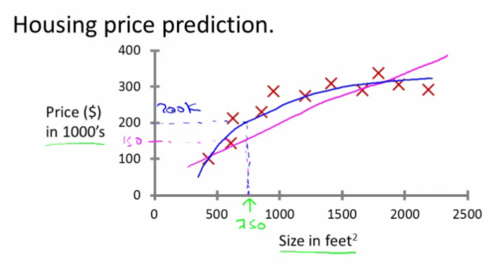
Credit: Andrew Ng, "Introduction to Machine Learning," Stanford
Unsupervised Learning
Process used for providing structure
No data was pre "structured", attempts to make sense out of independent variables
(you're making up, or the algorithm is making up, your dependent variable)
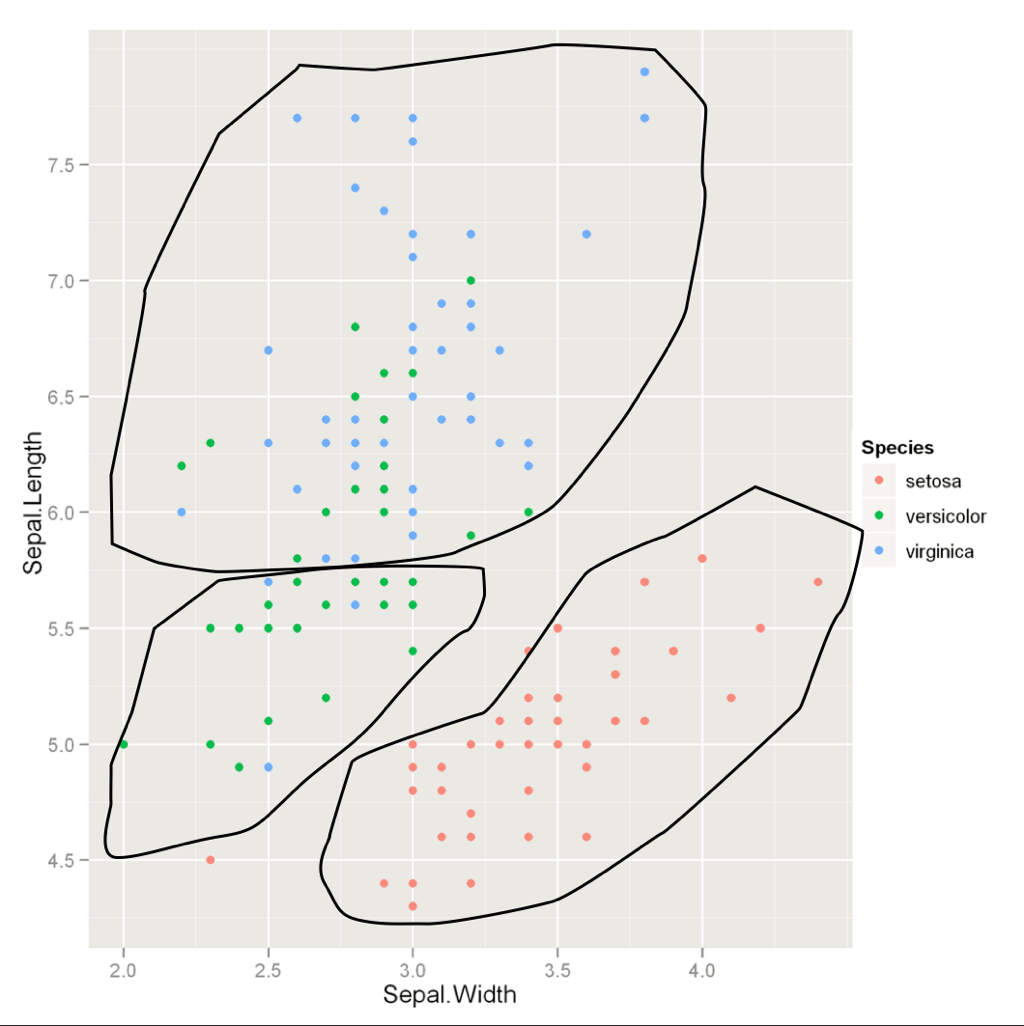
Credit: Thomson Nguyen, "Introduction to Machine Learning," Lookout
Types of Data:
| Continuous | Categorical |
|---|---|
| Quantitative | Qualitative |
The space where data live is called the feature space.
Each point in this space is called a record.
Note: these characterize the dependent (target) variables!
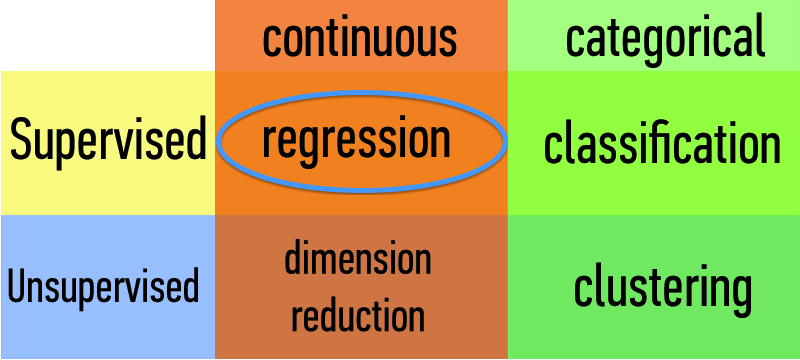
Fitting it all Together
What's the goal?

What data do we have?
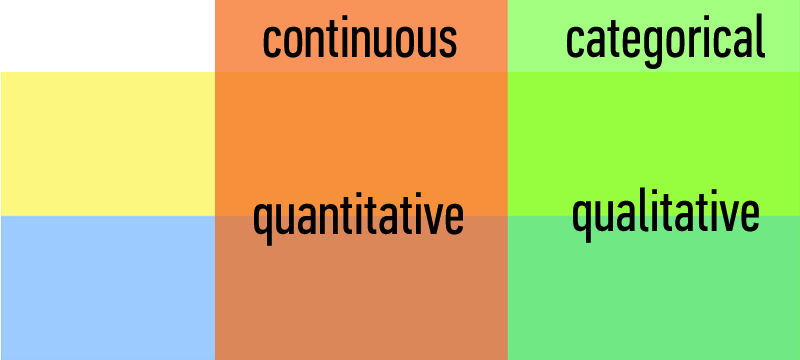
How do we determine the right approach?
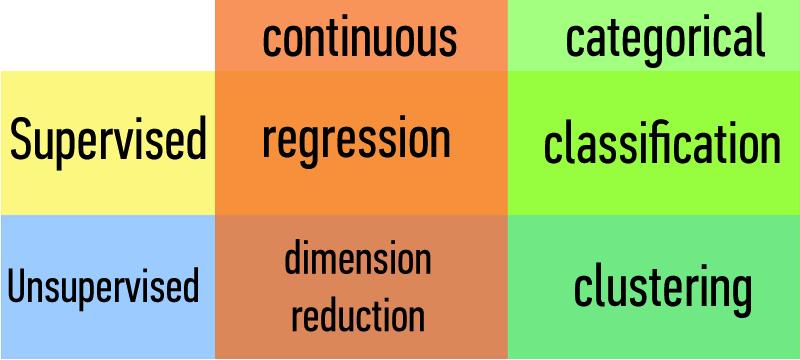
Q: do you know of any particular models/algorithms that fit into these categories?
Q: are these terms familiar?
Q: can you think of particular algorithms that fit into these categories?
Classification for targeting ads (likely purchasers), regression, clustering (recsys), dim reduction (mtx decomposition)
Combo: nnmf (netflix prize)
We will implement solutions using models and algorithms.
Each will fall into one of these four buckets.
Common linear regression model data problems
I know the prices for all of these other apartments in my area. What could I get for mine?
What's the relationship between total number of friends, posting activity, and the number of likes a new post would get on Facebook?
Careful! Time series data (believe it or not) does not always handle well with simple regression
Recall:
A regression model is a functional relationship between input & response variables.
$$ y = \alpha + \beta x + \epsilon $$
$y =$ response variable (the one we want to predict)
$x =$ input variable (the one we use to train the model)
$\alpha =$ intercept (where the line crosses the y-axis)
$\beta =$ regression coefficient (the model "parameter")
$\epsilon =$ residual (the prediction error)
Ordinary Least Squares
Q. How do we fit a regression model to a dataset?
A. Minimize the sum of the squared residuals (OLS)
$$ min(||y – \beta x||^2) $$
Aside
Why least squares?
We want to penalize both positive and negative residuals.
But why squares and not, say, absolute values?
In fact, in the late 18th century, both of these were considered. OLS won because of procedures making it easier to compute by hand. Today, OLS dominates largely for historical reasons though it is also helpful as it allows a direct comparison between the square of the residuals and the square of the standard deviation (or variance) of the model.
That said, minimizing absolute values may be prefered in cases where there are outliers. (Why?)
Polynomial Regression
Polynomial regression allows us to fit very complex curves to data.
$$ y = \alpha + \beta_1 x + \beta_2 x^2 + \ldots + \beta_n x^n + \epsilon $$
However, it poses one problem, particularly in comparison to simple linear regression
What's the difference between simple linear regression and polynomial regression?
What's the problem that simple regression doesn't have?
Multicollinearity
Multicollinearity is when predictor variables are highly correlated with each other
%matplotlib inline
%load_ext rmagic

import numpy as np
import matplotlib.pyplot as plt
import pandas as pd
import pandas.rpy.common as com
import statsmodels.formula.api as smf

from ipy_table import apply_theme, make_table
from statsmodels.stats.anova import anova_lm
x = np.arange(1,10.1,0.1)
np.corrcoef(x**9, x**10)[0,1]
This causes the model to break down because it can't tell the difference between predictor variables
plt.scatter(x**9, x**10)

How we fix multicollinearity
Replace the correlated predictors with uncorrelated predictors
$$ y = \alpha + \beta_1 f_1(x) + \beta_2 f_2(x^2) + \ldots + \beta_n f_n(x^n) + \epsilon $$
Technical Note: These polynomial functions form an orthogonal basis of the function space.
We will revisit this when we talk about Principal Components Analysis.
Multiple Regression
We can extend this model to several input variables, giving us the multiple linear regression model:
$y = \alpha + \beta_1 x_1 + \ldots + \beta_n x_n + \epsilon$
Description = ([
        ['Variable','Description'],
        ['lcavol', '(log) Cancer Volume'],
        ['lweight', '(log) Weight'],
        ['age', 'Patient age'],
        ['lbph', '(log) Vening Prostatic Hyperplasia'],
        ['svi', 'Seminal Vesicle Invasion'],
        ['lcp', '(log) Capsular Penetration'],
        ['gleason', 'Gleason score'],
        ['pgg45', 'Percent of Gleason score 4 or 5'],
        ['lpsa', '(log) Prostate Specific Antigen'],
        ['train', 'Label for test / training split']])
%%R
library(ElemStatLearn)
data(prostate)
Prostate data
For more information on the Gleason score.
#make_table(Description)
#apply_theme('basic')
prostate = com.load_data('prostate')
_ = pd.scatter_matrix(prostate, figsize=(12,6))

Specifying the model
We will use variables
lcavol, lweight, age, lbph, svi, lcpandpgg45.Rather than one predictor, we have $p=7$ predictors.
$$Y_i = \beta_0 + \beta_1 X_{i1} + \dots + \beta_p X_{ip} + \varepsilon_i$$
Errors $\varepsilon$ are assumed independent $N(0,\sigma^2)$, as in simple linear regression.
Coefficients are called (partial) regression coefficients because they “allow” for the effect of other variables.
Fitting the model
Just as in simple linear regression, model is fit by minimizing $$\begin{aligned} SSE(\beta_0, \dots, \beta_p) &= \sum_{i=1}^n(Y_i - (\beta_0 + \sum_{j=1}^p \beta_j \ X_{ij}))^2 \\ &= \|Y - \widehat{Y}(\beta)\|^2 \end{aligned}$$
Minimizers: $\widehat{\beta} = (\widehat{\beta}_0, \dots, \widehat{\beta}_p)$ are the “least squares estimates”: are also normally distributed as in simple linear regression.
mod = smf.ols('lpsa ~ lcavol + lweight + age + lbph + svi + lcp + pgg45', data=prostate)
res = mod.fit()
res.params
Estimating $\sigma^2$
As in simple regression $$\widehat{\sigma}^2 = \frac{SSE}{n-p-1} \sim \sigma^2 \cdot \frac{\chi^2_{n-p-1}}{n-p\ -1}$$ independent of $\widehat{\beta}$.
Why $\chi^2_{n-p-1}$? Typically, the degrees of freedom in the estimate of $\sigma^2$ is $n-\# \text{number of parameters in regression function}$.
'Residual standard error: {:.3}'.format(np.sqrt(res.ssr/res.df_resid))
$\widehat{\sigma}^2 is also known as the scale of the model.
'Residual standard error: {:.3}'.format(np.sqrt(res.scale))
Interpretation of $\beta_j$’s
Take $\beta_1=\beta_{\tt{lcavol}}$ for example. This is the amount the
lpsarating increases for one “unit” oflcavol, keeping everything else constant.We refer to this as the effect of
lcavolallowing for or controlling for the other variables.For example, let's take the 10th case in our data and change
lcavolby 1 unit.
case1 = prostate[9:10]
case2 = case1.copy()
case2.lcavol += 1
yhat = res.predict(pd.concat([case1,case2]))
yhat
Our regression model says that this difference should be $\hat{\beta}_{\tt lcavol}$.
yhat[1] - yhat[0], res.params['lcavol']
Goodness of fit for multiple regression
$$\begin{aligned} SSE &= \sum_{i=1}^n(Y_i - \widehat{Y}_i)^2 \\ SSR &= \sum_{i=1}^n(\overline{Y} - \widehat{Y}_i)^2 \\ SST &= \sum_{i=1}^n(Y_i - \overline{Y})^2 \\ R^2 &= \frac{SSR}{SST} \end{aligned}$$
$R^2$ is called the multiple correlation coefficient of the model, or the coefficient of multiple determination.
The sums of squares and $R^2$ are defined analogously to those in simple linear regression.
Y = prostate.lpsa
n = len(Y)
SST = sum((Y - Y.mean())**2)
SSE = sum(res.resid**2)
SSR = SST - SSE
SSR/SST
Adjusted $R^2$
As we add more and more variables to the model – even random ones, $R^2$ will increase to 1.
Adjusted $R^2$ tries to take this into account by replacing sums of squares by mean squares $$R^2_a = 1 - \frac{SSE/(n-p-1)}{SST/(n-1)} = 1 - \frac{MSE}{MST}.$$
MSE = SSE / res.df_resid
MST = SST / (n - 1)
1 - MSE/MST
Goodness of fit test
As in simple linear regression, we measure the goodness of fit of the regression model by $$F = \frac{MSR}{MSE} = \frac{\|\overline{Y}\cdot {1} - \widehat{{Y}}\|^2/p}{\\ |Y - \widehat{{Y}}\|^2/(n-p-1)}.$$
Under $H_0:\beta_1 = \dots = \beta_p=0$, $$F \sim F_{p, n-p-1}$$ so reject $H_0$ at level $\alpha$ if $F > F_{p,n-p-1,1-\alpha}.$
print res.summary()
MSR = SSR / (n - 1 - res.df_resid)
MSR / MSE
Inference for multiple regression
Regression function at one point
One thing one might want to learn about the regression function in the supervisor example is something about the regression function at some fixed values of ${X}_{1}, \dots, {X}_{6}$, i.e. what can be said about $$ \begin{aligned} \beta_0 + 1.3 \cdot \beta_1 &+ 3.6 \cdot \beta_2 + 64 \cdot \beta_3 + \\ 0.1 \cdot \beta_4 &+ 0.2 \cdot \beta_5 - 0.2 \cdot \beta_6 + 25 \cdot \beta_7 \tag{*}\end{aligned}$$ roughly the regression function at “typical” values of the predictors.
The expression above is equivalent to $$\sum_{j=0}^7 a_j \beta_j, \qquad a=(1,1.3,3.6,64,0.1,0.2,-0.2,25).$$
Confidence interval for $\sum_{j=0}^p a_j \beta_j$
Suppose we want a $(1-\alpha)\cdot 100\%$ CI for $\sum_{j=0}^p a_j\beta_j$.
Just as in simple linear regression:
$$\sum_{j=0}^p a_j \widehat{\beta}_j \pm t_{1-\alpha/2, n-p-1} \cdot SE\left(\sum_{j=0}^p a_j\widehat{\beta}_j\right).$$
statsmodels' will form these coefficients for each coefficient separately when using the conf_int function. These linear combinations are of the form
$$
a_{\tt lcavol} = (0,1,0,0,0,0,0,0)
$$
so that
$$
a_{\tt lcavol}^T\widehat{\beta} = \widehat{\beta}_1 = {\tt coef(prostate.lm)[2]}
$$
print res.conf_int(alpha=.1)
$T$-statistics revisited
Of course, these confidence intervals are based on the standard ingredients of a $T$-statistic.
Suppose we want to test $$H_0:\sum_{j=0}^p a_j\beta_j= h.$$ As in simple linear regression, it is based on $$T = \frac{\sum_{j=0}^p a_j \widehat{\beta}_j - h}{SE(\sum_{j=0}^p a_j \widehat{\beta\ }_j)}.$$
If $H_0$ is true, then $T \sim t_{n-p-1}$, so we reject $H_0$ at level $\alpha$ if $$\begin{aligned} |T| &\geq t_{1-\alpha/2,n-p-1}, \qquad \text{ OR} \\ p-\text{value} &= {\tt 2*(1-pt(|T|, n-p-1))} \leq \alpha. \end{aligned}$$
statsmodels produces these in the summary of the linear regression model. Again, each of these
linear combinations is a vector $a$ with only one non-zero entry like $a_{\tt lcavol}$ above.
print res.summary()
Questions about many (combinations) of $\beta_j$’s
In multiple regression we can ask more complicated questions than in simple regression.
For instance, we could ask whether
lcpandpgg45explains little of the variability in the data, and might be dropped from the regression model.These questions can be answered answered by $F$-statistics.
Note: This hypothesis should really be formed before looking at the output of
summary.Later we'll see some examples of the messiness when forming a hypothesis after seeing the
summary...
Dropping one or more variables
Suppose we wanted to test the above hypothesis Formally, the null hypothesis is: $$ H_0: \beta_{\tt lcp} (=\beta_6) =\beta_{\tt pgg45} (=\beta_7) =0$$ and the alternative is $$ H_a = \text{one of $ \beta_{\tt lcp},\beta_{\tt pgg45}$ is not 0}. $$
This test is an $F$-test based on two models $$\begin{aligned} Full: Y_i &= \beta_0 + \sum_{j=1}^7 \beta_j X_{ij} \beta_j + \varepsilon_i \\ Reduced: Y_i &= \beta_0 + \sum_{j=1}^5 \beta_j X_{ij} + \varepsilon_i \\ \end{aligned}$$
Note: The reduced model $R$ must be a special case of the full model $F$ to use the $F$-test.
$F$-statistic for $H_0:\beta_{\tt lcp}=\beta_{\tt pgg45}=0$
We compute the $F$ statistic the same to compare any models $$\begin{aligned} F &=\frac{\frac{SSE(R) - SSE(F)}{2}}{\frac{SSE(F)}{n-1-p}} \\ & \sim F_{2, n-p-1} \qquad (\text{if $H_0$ is true}) \end{aligned}$$
Reject $H_0$ at level $\alpha$ if $F > F_{1-\alpha, 2, n-1-p}$.
When comparing two models, one a special case of the other (i.e.
one nested in the other), we can test if the smaller
model (the special case) is roughly as good as the
larger model in describing our outcome. This is typically
tested using an F test based on comparing
the two models. We can use anova_lm to do this.
reduced_lm = smf.ols("lpsa ~ lcavol + lweight + age + lbph + svi", data=prostate).fit()
print anova_lm(reduced_lm, res)
LAB
In the DAT6 folder, from the command line:
git commit -am 'your message here'
git checkout gh-pages
git pull
git checkout personal
git merge gh-pages
ipython notebook
Then open DS_Lab06-ML